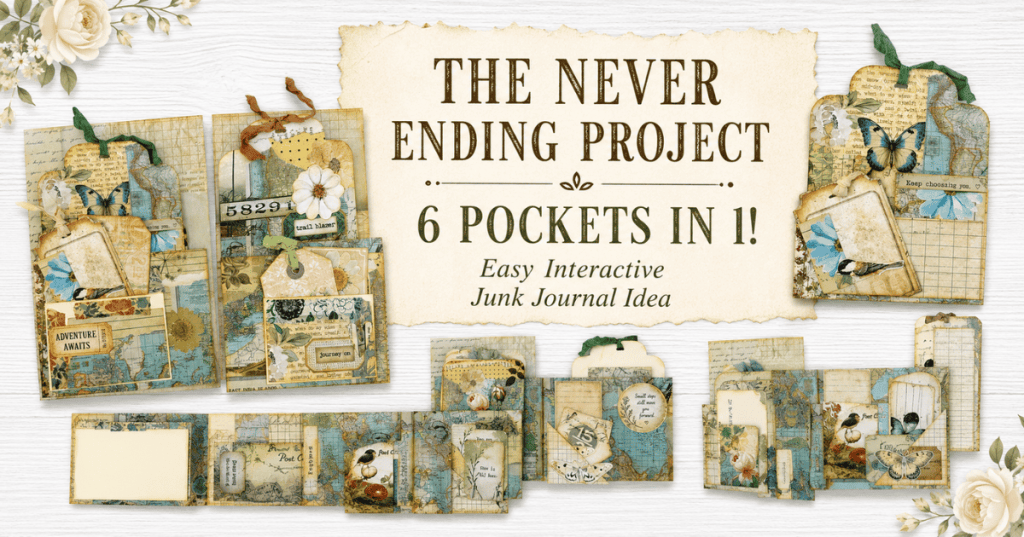
At first glance, this looks like one nice big pocket on a junk journal page.
Then you open it.
And there’s another pocket.
And another.
And another.
That’s why I’m calling this one the Never Ending Pocket! By the time everything is opened up, this interactive paper project gives you six pockets altogether, plus plenty of opportunities to add extra tuck spots, tags, journaling cards, and little bits of ephemera.
It’s one of those projects that looks much more complicated than it really is—which, of course, is exactly the kind of project I love.
What Is a Never Ending Pocket?
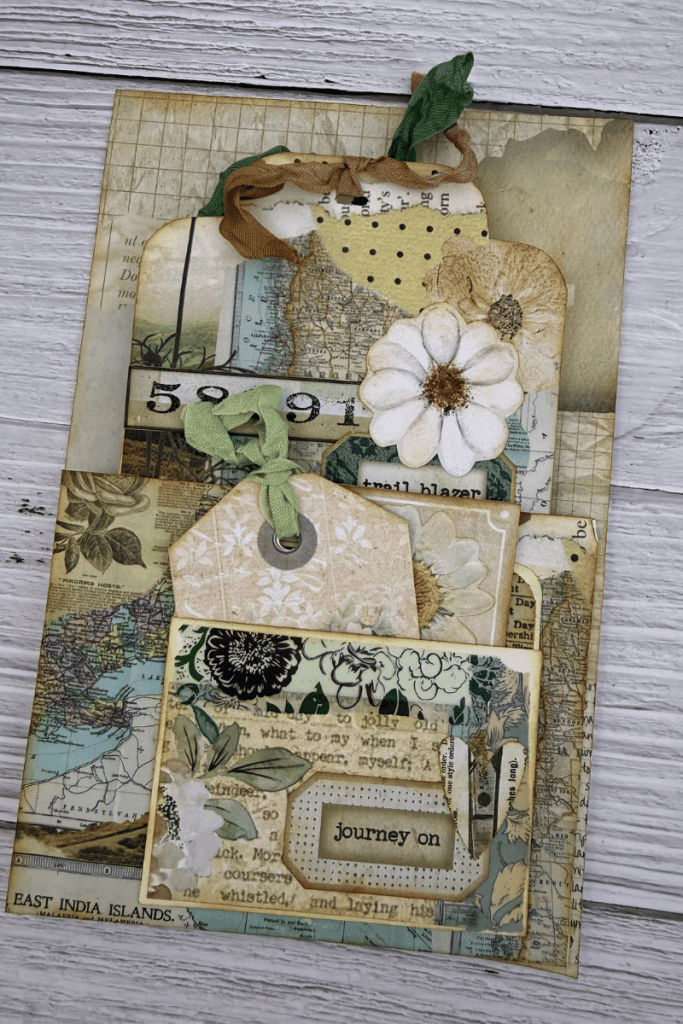
When it’s closed, the project looks like a large pocket that you could simply attach to a journal page.
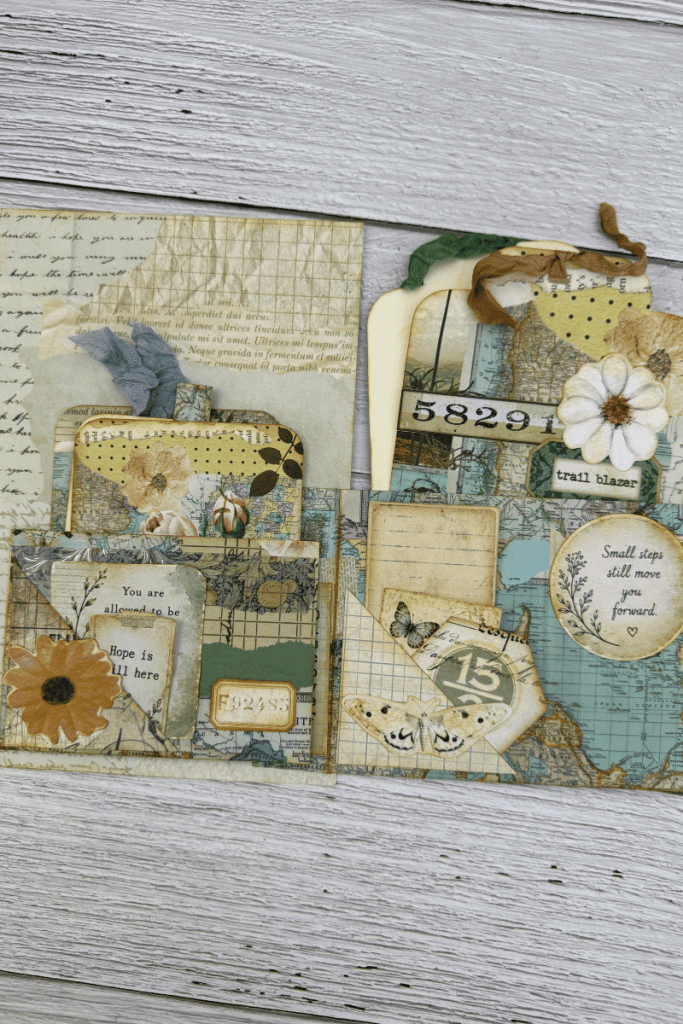
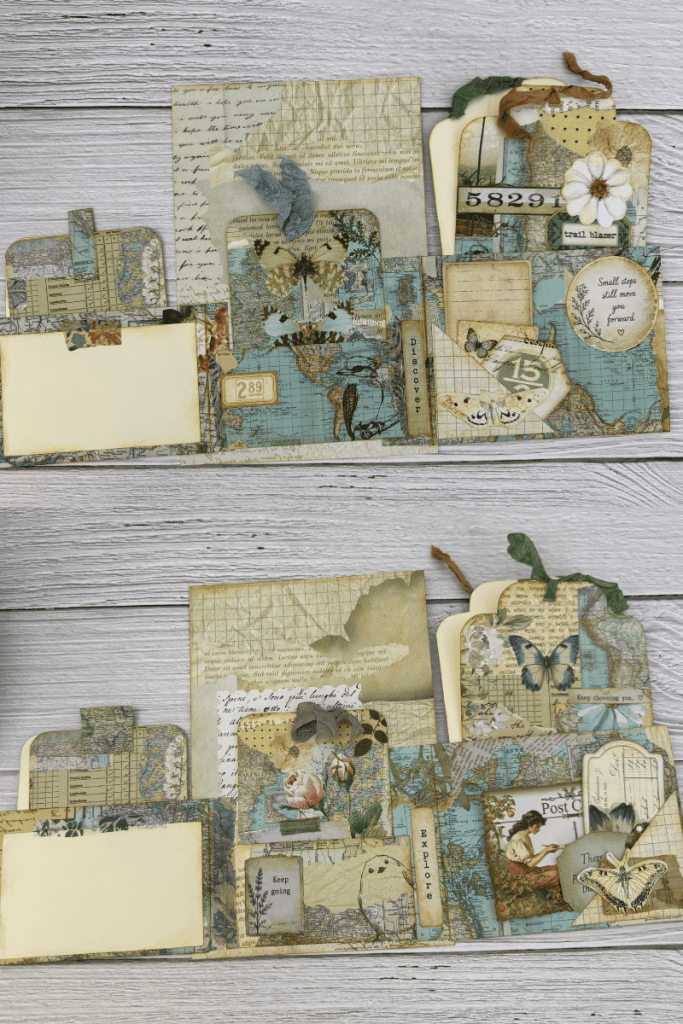
But as you begin opening the different sections, more pockets are revealed underneath. Each layer gives you another place to tuck something in, making this a really fun interactive element for a junk journal, folio, altered book, or happy mail project.
Mine ended up with six pockets, and you could certainly continue embellishing it with little tuck spots and additional mini pockets if you wanted.
Papers and Supplies
For my project, I used papers from my Collage Papers No. 4 — Vintage Maps collection, along with pieces from my Doodad Folder and scraps that were already sitting on my desk. You do not need those particular papers to make the project, though. This is a great one for using what you already have.
You’ll need:
- Three pieces of paper cut to the measurements below
- Paper trimmer or scissors
- Score board or scoring tool
- Adhesive
- Ink, if you like to ink your edges
- Tags, journaling cards, labels, tickets, scraps, or other ephemera for filling and decorating your pockets
Find my printable kits in my Etsy shop here:
https://silver-sparkles.com/2RvdfSp
Never Ending Pocket Measurements
Piece 1 — Main Pocket
Cut one piece of paper 6″ x 8″
With the 6-inch side at the top of your scoreboard Score at 5″
Then turn your paper and fold it in half along the 8-inch side.
Piece 2 — Inner Pocket
Cut one piece of paper 4 3/4″ x 6″
With the 4 3/4-inch side at the top of your scoreboard Score at 1/2″
Then fold the paper in half along the 6-inch side.
Piece 3 — Small Pocket
Cut one piece of paper 3 3/4″ x 2″
There is no complicated measuring involved beyond those three pieces.
TIP: Paper orientation matters when assembling the different layers, so watch the video before permanently gluing everything in place.
Watch the Never Ending Pocket Tutorial
If you’re making this for the first time, I recommend cutting all three pieces first and then having them beside you while you watch. Once you see how those layers fit together, the construction makes much more sense.
Then Comes the Fun Part: Fill Those Pockets!
Once the basic structure is finished, you get to decide what all those pockets will hold.
I tucked in a mix of pieces from my Doodad Folder along with scraps and bits that were already on my desk.
You could fill yours with:
- Journaling cards
- Tags
- Tickets
- Labels
- Book pages
- Vintage-style ephemera
- Small photographs
- Notes
- Quotes
- Botanical pieces
- Little handmade embellishments
- Scraps left over from the rest of your journal
And remember—you do not have to fill every pocket right away.
Leaving a few empty gives whoever eventually uses the journal somewhere to add their own treasures.
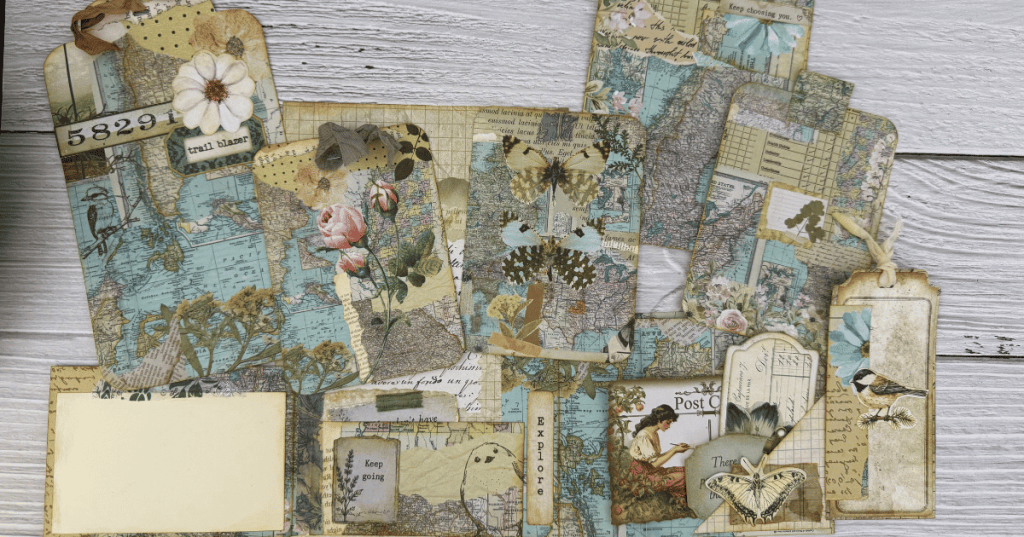
Use Those Desk Scraps
One of my favorite things about projects like this is that the basic construction gives you somewhere to use all those pretty little pieces that seem too good to throw away.
You know the ones.
A bit of torn paper.
Half a label.
A ticket.
A strip of book page.
A tiny piece of lace.
Something left over from yesterday’s project that is still sitting beside the glue bottle.
Those pieces are perfect for layering onto the fronts of the different pockets or turning into the tags and cards that go inside them.
You don’t need to pull out twenty different supplies. Start with the basic pocket construction and then use what’s already around you.
A Few Tips Before You Start
Don’t glue too soon.
Lay everything together and practice opening the different sections before committing with adhesive.
Keep checking your pocket openings.
It is surprisingly easy to get carried away with the glue and accidentally seal an opening.
Use your scraps for embellishing.
This project already has plenty going on mechanically. You don’t need complicated decorations.
Think about bulk.
Six pockets can hold a lot! If this is going inside a journal, you may want to use flatter ephemera rather than stuffing every pocket with thick embellishments.
Make the next one your own.
Once you understand the construction, try changing the papers, embellishments, or way you fill the pockets. Two Never Ending Pockets could use exactly the same measurements and still look completely different.
Where Could You Use It?
The Never Ending Pocket would be fun:
- On a full junk journal page
- Inside a folio
- On the inside cover of a journal
- As an interactive element in an altered book
- Inside happy mail
- As a little standalone ephemera holder
- Filled with notes or memories as a gift
I especially love interactive projects like this because they invite someone to do something with the journal rather than simply look at the page.
There’s always one more little place to discover.
Make One With Me
If you make a Never Ending Pocket, I hope you’ll put your own spin on it and see just how many interesting little things you can tuck inside.
And if the written measurements are beside you while you craft, use the video for the exact paper orientation and assembly. I’ll walk you through each fold and show you how all of those seemingly simple paper pieces turn into one very fun interactive pocket.
Shop Silver & Sparkles on Etsy: https://silver-sparkles.com/9V1LQSU
Happy creating!
— Pam
Silver & Sparkles

Leave a Reply